Taste Engine Logo Taste Engine v0.13.1
10 Curated Aesthetics · Zero AI-Slop · 100% Contrast Safe (WCAG AA)

Frontend Design Intelligence
for Autonomous AI Agents

Taste Engine equips Antigravity, Claude Code, and OpenAI Codex with 10 distinctive aesthetic archetypes, mathematical token scales, and paired dark/light mode contrast gating.

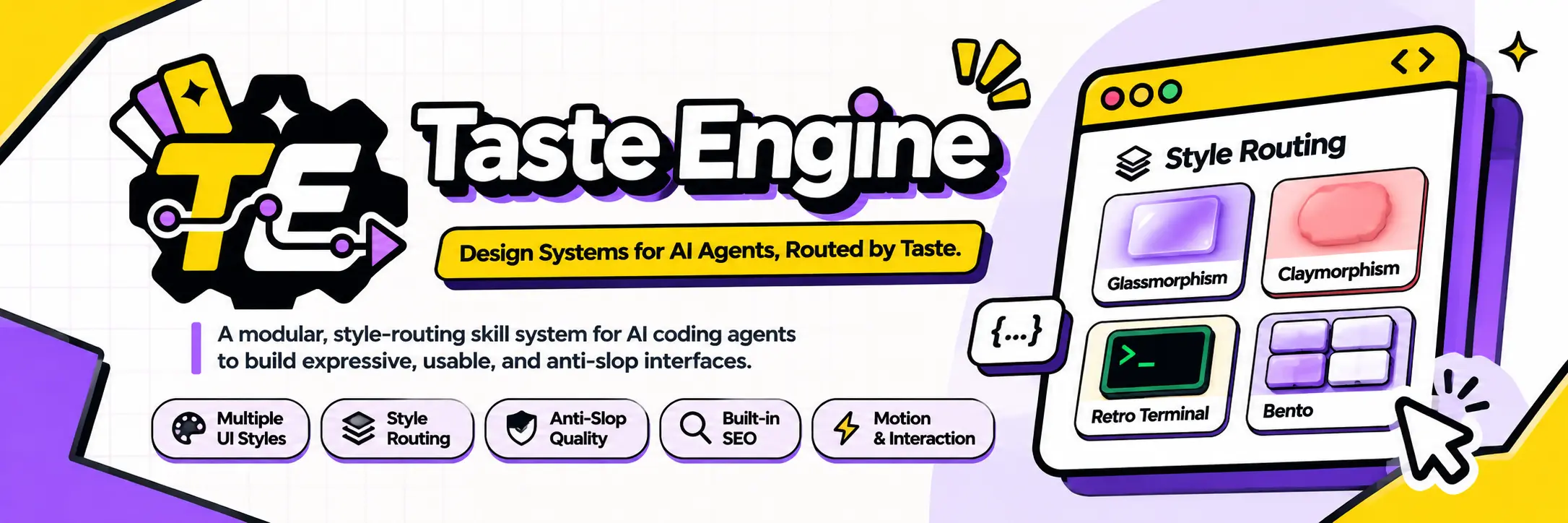
Taste Engine Official Banner
$ npx skills add kennedys0/taste-engine
Explore 10 Styles Installation Guide
10 Aesthetic Archetypes
100% WCAG AA Contrast Gated
0 AI-Slop Clichés
Multi-Agent Antigravity · Claude · Codex
Interactive Gallery

Live Material Fidelity Preview

Test all 10 styles across dark and light modes. Every component adheres to paired token coupling with guaranteed WCAG AA readability.

Brutalism

Raw structural scaffolding, 0px corners, Raw & Bento variants
PoW Guide →
VARIANT:
[2 VARIANTS]
INDEX // RAW_SCAFFOLD_01 [2026 // ONLINE]

WE DESIGN WITHOUT AI SLOP.

Frontend intelligence for AI agents. Continuous 2px blueprint grid borders. High-voltage caution yellow and signal red accents.

LATENCY 0ms FLIP
RADIUS STRICT 0PX
VIEW FULL POW →

Claymorphism

Volumetric dual inner shadows, molded porcelain surfaces
PoW Guide →

Tactile Clay Card

Soft incident highlight (top-left) opposes volumetric form shadow (bottom-right).

Frutiger Aero

Optimistic sky/aqua gloss, Glassmorphism + Skeuomorphism fusion
PoW Guide →
EXPR:
GLASS + SKEUO

Optimistic Computing Sky

Refractive sky-glass panels paired with 5-stop molded aqua acrylic push buttons and top horizon sheens.

Minimalism / Enterprise

Purposeful restraint, hairline data cockpits & calibrated status
PoW Guide →

Restrained Telemetry

● 12 Nodes Online

Purposeful whitespace, tabular-nums alignment, and zero consumer dashboard clutter.


cluster-eu-west // 14ms Inspect Cockpit →

Neo-brutalism

2.5px solid stroke, 4px hard offset shadow, pop color
PoW Guide →

CONFIDENT POP!

Solid borders with unblurred offset shadows and tactile 2px mechanical displacement.

Retro-Terminal

CRT phosphor glow, static scanlines & monospace CLI prompt
PoW Guide →
[TASTE_OS v0.13.1 / SYS_READY]

> Core diagnostic: ALL SYSTEMS NOMINAL.
> Memory heap: 640K OK.

user@system:~$ deploy --prod

Swiss / Editorial

Grid typography, massive scale contrast & hairline rules
PoW Guide →
[ 01 / ARCHITECTURE ] 12-COL ASYMMETRIC

TYPOGRAPHIC SCALE.


Strict 12-column rhythm with authoritative grotesque typography and singular Swiss red signal accent.

ZURICH_1957 ↗

Retro Pixel

8-bit & 16-bit desktop GUI, stepped bevels, arcade orange & teal
PoW Guide →
[WORKSTATION_16BIT.EXE] _ □ ×
Crafted 16-bit computing: integer-aligned pixel art, desktop purple title bars, stepped 3D button displacement, and WCAG AA contrast.
OPEN STUDIO → 16-BIT ACTIVE

Art Deco

Architectural geometry, stepped chevrons, Modern, Classic & Minimal
PoW Guide →
EXPRESSION:
[3 EXPRESSIONS]
[ATELIER // MODERN_AXIAL] FOREST & BRASS

ARCHITECTURAL BALANCE.

Contemporary whitespace discipline, fine geometric hairline frames, and zero yellow-gradient slop.

FINISH FLAT BRASS #B69A68
CONTRAST WCAG AA 7.2:1
OPEN SALON → DEFAULT

Y2K Futurism

Liquid chrome, iridescent spectral finishes & translucent polymers
PoW Guide →
EXPR:
Y2K // 2000

Liquid Chrome Core

Multi-band specular silver reflections, molded hardware bezels, and tactile polymer shells.

Explore Millennium → SPECULAR SILVER
Architecture Flow

How Taste Engine Works

From a user prompt to a production-grade interface — here is the 4-phase transformation pipeline executed by your AI agent.

Phase 01

Archetype Discovery

The agent inspects project context, domain, and user persona. It maps requirements to the optimal visual archetype (e.g. Fintech → Data Cockpit, Dev Tools → Retro Terminal or Swiss Editorial) before writing UI code.

  • Context-to-aesthetic mapping
  • Persona & tone calibration
  • Eliminates generic blue templates
Phase 02

Mathematical Tokens

Injects structured design tokens: calibrated typographic ratios, strict 4px/8px spatial rhythm, specific border radii, and predictable CSS variables instead of arbitrary inline styles.

  • Strict font & scale pairings
  • Consistent shadow elevations
  • Standardized CSS variables
Phase 03

Paired Dark/Light Coupling

Background, surface, ink (text), and border tokens invert in mathematically synchronized pairs. Completely prevents contrast collisions such as black text on dark surfaces or white on white.

  • Guaranteed WCAG AA (min 4.5:1)
  • Automatic [data-theme] inversion
  • Zero manual color patching
Phase 04

Anti-Slop Quality Gate

Before delivering code, the agent validates the UI against the 7 Universal Quality Gates: no floating ungrounded cards, no generic AI glow halos, no meaningless glassmorphism, and full state completeness.

  • Bans repetitive AI cliches
  • Enforces hover & active states
  • Production-ready clean CSS
Installation

Install in Seconds

Select your target AI Agent environment below to get the single-line installation command.

Antigravity IDE — Global or Project Setup
# Global install across all Antigravity workspaces:
node bin/taste-engine.mjs install --agent antigravity --global

# OR local install into the current project workspace:
node bin/taste-engine.mjs install --agent antigravity
Antigravity CLI (agy)
# Add via Universal Skills CLI:
npx skills add kennedys0/taste-engine

# Verify installed skill in agy CLI:
agy skills list
Anthropic Claude Code
# Installation via Taste Engine installer:
node bin/taste-engine.mjs install --agent claude --global

# OR installation via Skills CLI:
npx skills add kennedys0/taste-engine
OpenAI Codex & GitHub Copilot Workspace
# Global installation for Codex / Copilot:
node bin/taste-engine.mjs install --agent codex --global

# OR project installation:
node bin/taste-engine.mjs install --agent codex
Universal Skills CLI (npx skills)
# Install the entire Taste Engine pack in one command:
npx skills add kennedys0/taste-engine

# List installed skills on your machine:
npx skills list
Single Standalone Style Installation
# Install only the Minimalism & Data Cockpit style:
npx skills add kennedys0/taste-engine --skill taste-style-minimalism

# Install only the Retro Pixel style:
npx skills add kennedys0/taste-engine --skill taste-style-retro-pixel

# Install only the Neo-Brutalism style:
npx skills add kennedys0/taste-engine --skill taste-style-neo-brutalism

# Install only the Claymorphism style:
npx skills add kennedys0/taste-engine --skill taste-style-claymorphism

# Install only the Swiss / Editorial style:
npx skills add kennedys0/taste-engine --skill taste-style-swiss-editorial

# Install only the Frutiger Aero style (canonical pack for glass & skeuomorphism):
npx skills add kennedys0/taste-engine --skill taste-style-frutiger-aero

Preview All Styles Offline in Your Browser

Run this command in your repository terminal at any time to open this interactive showcase locally:

node bin/taste-engine.mjs gallery
FAQ

Frequently Asked Questions

Technical answers on framework independence, contrast gating, codebase preservation, and custom styling.

By default, AI coding agents generate uniform, repetitive frontend designs (often termed AI-slop): ungrounded floating cards, low-contrast text, purposeless blur effects, and generic blue-purple gradients.

Taste Engine is an intelligence skill pack that equips AI agents with 10 distinctive aesthetic archetypes (Art Deco with Modern, Classic & Minimal expressions, Brutalism with Raw & Bento variants, Claymorphism, Frutiger Aero with Classic, Glass & Tactile expressions, Minimalism with Enterprise data cockpits, Neo-Brutalism, Retro Terminal, Retro Pixel, Swiss Editorial, and Y2K Futurism) backed by strict quality gates to produce production-grade frontend code. Legacy glassmorphism and skeuomorphism requests automatically resolve to Frutiger Aero variants.

No. Taste Engine is 100% framework-agnostic. It injects pure design principles, mathematical tokens, and native CSS recipes.

You can use it seamlessly with React, Next.js, Vue, Svelte, Nuxt, Astro, HTML/CSS, Tailwind CSS, shadcn/ui, MUI, or any other UI stack.

Every style in Taste Engine enforces Strict Paired Coupling. Tokens for background, surface, ink (text), and borders are defined as synchronized mathematical pairs.

When toggling between [data-theme="dark"] and [data-theme="light"], all token pairs invert symmetrically and are guaranteed to meet minimum WCAG AA (≥ 4.5:1) readability standards. Anti-slop quality gates explicitly ban dark text on dark surfaces or pale text on light cards.

No. Taste Engine is non-destructive and additive. All tokens and CSS classes use unique namespaces such as --taste-[style]-*, ensuring zero collision with your global stylesheets.

Quality gates also instruct the agent to respect existing component architecture and naming conventions in established projects.

Yes. Taste Engine provides 10 independent standalone skills in the optional-standalone-skills/ directory. You can install each style individually using:

npx skills add kennedys0/taste-style-[style-name]

For example: npx skills add kennedys0/taste-engine --skill taste-style-minimalism or npx skills add kennedys0/taste-engine --skill taste-style-swiss-editorial. This minimizes token usage if your project only requires a single aesthetic.

In Antigravity IDE, check your installed skills list or run agy skills list in the CLI.

To test directly in chat, ask: "Use Taste Engine to review and redesign this card component with a Bento Grid aesthetic." Your agent will recognize the skill and apply its architectural constraints.

Yes. You can override CSS custom properties in your stylesheets (for example, overriding --taste-neo-accent: #ffe600; or --taste-bento-accent-cta: #ff5722;).

To contribute a new aesthetic pack, add a markdown specification in skills/taste-engine/styles/ and validate it with our test runner: python3 skills/taste-engine/scripts/validate-pack.py.

Design Tokens

Standard Token Architecture

Every style follows a standardized CSS variable naming convention, easily mapped to Tailwind CSS theme configuration or plain CSS custom properties.

CSS Variable Pattern Semantic Role Dark Mode Behavior Light Mode Behavior
--taste-[style]-bg Canvas background layer Deep matte charcoal / velvety graphite Crisp white / soft pale slate tint
--taste-[style]-surface Card, panel, and modal containers Elevated matte surface with subtle bevel Clean elevated card with soft rim
--taste-[style]-text Primary readable typography High-contrast crisp white (min 4.5:1) High-contrast slate/black (min 4.5:1)
--taste-[style]-muted Secondary labels & subtitles Medium cool grey (accessible contrast) Medium slate grey (accessible contrast)
--taste-[style]-border Card outlines & structural lines Subtle translucent white rim Subtle translucent dark rim
--taste-[style]-accent Primary action buttons & indicators High-chroma highlight Deep, contrast-anchored highlight
Quick Starter CSS Boilerplate
/* Root Dark Theme Default (Codex Slate-Grey) */
:root {
  --app-bg: var(--taste-bento-bg, #212328);
  --app-surface: var(--taste-bento-surface, #2b2e36);
  --app-text: var(--taste-bento-text, #f3f4f6);
  --app-border: var(--taste-bento-border, rgba(255, 255, 255, 0.12));
  --app-accent: var(--taste-bento-accent, #10b981);
}

/* Light Theme Transition */
[data-theme="light"] {
  --app-bg: #f7f7f8;
  --app-surface: #ffffff;
  --app-text: #202123;
  --app-border: rgba(0, 0, 0, 0.10);
  --app-accent: #059669;
}
Command copied to clipboard!